Workshop: CAQDAS Projects and Digital Repositories


QDR Blog

skarcher

DOI For this blog post: https://doi.org/10.59350/5znft-x4j11

The scientific response to the global pandemic has shown, among other things, the value of open science, collaboration, and data sharing. In that spirit, QDR will support efforts to share qualitative and multi-method social science data underlying COVID-19 related research.

sign for COVID-19 testing center
Photo by Colin D on Unsplash

Social scientists are contributing important insights to understanding and addressing challenges caused by the pandemic. There is a growing public list of ongoing social science work related to COVID-19. Major funders such as NSF and SSRC are soliciting research proposal as part of dedicated projects, and journals such as Perspectives on Politics are inviting manuscripts for special issues.

Guided by our mission, we at QDR believe that the impact of these efforts will be enhanced if underlying data are shared ethically wherever possible. We will work with interested researchers to devise a plan for organizing and sharing data, and will curate those data, publish it on QDR (with appropriate access controls if warranted), and preserve it for the long-run.

Please contact us at qdr@syr.edu if you are interested in a consultation for your project or simply want to learn more about the repository.

1a36fd60-67d8-4e6e-a01d-56f0c57241ae
skarcher

DOI: https://doi.org/10.59350/5znft-x4j11

Welcome to Love Data Week. Every year, research data professionals from libraries, data repositories, and other organizations celebrate great ways to use data and best practices in taking care of research data. You can find lots of us tweeting using #LoveData20 or #LoveDataWeek. At QDR, we’re celebrating this year by releasing our first software tool for researchers, the R package archivr (pronounced “archiver”).

The Problem

If you have done any research using web sources, you have probably run into this issue:

Firefox I can't find this page message

You used a web resource – a blogpost, a newspaper article, a statement from an organization – but when you want to come back to it, you can no longer find it. Even if you were smart enough to save the page at the time or you used a tool like Evernote or Zotero to take a Snapshot, citing the now gone webpage is of little help to other researchers who may want to follow up on your claims about it

A Solution

When this happens to you as a reader – e.g., when, you find a webpage cited that is no longer online, you may have used the WaybackMachine, an incredibly useful tool by the Internet Archive, a non-profit organization. The WaybackMachine allows you to look up a website and find an archived copy. Webpages associated with the Love Data Week event actually provide some great examples of this – the event used to be called “Love Your Data Week” but had to drop the name, and associated website https://loveyourdata.wordpress.com/, due to an existing trademark. While the live pages have disappeared, the Internet Archive allows us to find many archived copies of this site.


Old Love Your Data Week banner
The banner for the first Love (Your) Data Week in 2016 from the WaybackMachine.


But this only works for sites that the Internet Archive has saved automatically. Sites that are only available for a short time and/or haven’t been linked to widely are often not archived in the Internet Archive. This is particularly true for non-English sources.

This is where archivr comes in. It allows you to automatically save all URLs in a spreadsheet or a Word file ro the Internet Archive or perma.cc, a similar service run by a consortium of libraries led by the Harvard Law Library. So if you, for example, listed 100 URLs you consulted in an Excel sheet, you can make sure they’re archived. If you’ve written a chapter, or even an entire dissertation, archivr will find all URLs in the text and make sure they are archived.

By using archivr, you can be sure that scholars will always have access to the web pages you relied on.

At QDR, we have been using this tool for curation for several months now. We worked together with Agile Humanities’ Ryan Deschamps in building the original prototype and have since taken over maintenance of the tool.

An Example

In her masterful book Authoritarian Apprehensions, Lisa Wedeen draws, among other things, on 100s of web sources, many of them from Syria and thus particularly prone to disappearance. When curating data accompanying Lisa Wedeen’s book, QDR used archivr to make archived copies of all those sources, ensuring they’ll remain available. If readers of the book find a URL that is no longer working, they can simply search for it in the spreadsheet of archived URLs on QDR and find an archived copy instead

Excel sheet with archived URLS

Using archivr

Archivr is easy to use, including for R-novices. Basic installation and usage instructions are included in the readme and detailed instructions and examples are in the built-in documentation.

If you are using archivr, please let us know what you think. If you have any feature requests or bug reports, email us at qdr@syr.edu or create an issue on the project’s github repository.

fbfffc11-1c5e-40bf-9a67-48b54df9da40
skarcher

QDR Can Help

In a recent “Dear Colleague Letter”, the National Science Foundation (NSF) encourages researchers to adopt best practices in managing research data. NSF frequently uses “DCLs” to make researchers aware of funding priorities and preferred practices, so if you are thinking of applying for NSF funding, you should pay close attention to such pronouncements.

Endorsed by US Social Science Data Repositories

The Data Preservation Alliance for the Social Sciences (< a href="http://www.data-pass.org/">Data-PASS), in which many of the social science data repositories in the US – including QDR – are organized, has strongly endorsed the NSF's efforts on this. Data repositories can be instrumental in helping researchers achieve the "effective practices for data" that NSF is looking for.

Top of NSF DCL on Effective Practices for Data

The NSF points to two specific things it wants researchers to pay close attention to:

1. Persistent IDs for Data

The most important “persistent identifier” in scholarly publishing is the Digital Object Identifier (DOI). You likely have seen DOIs, which always start with “10.” and allow you to create stable links to resources (e.g. the link to my article on DOIs below is its DOI, 10.5281/zenodo.2563130, prefix it with https://doi.org and you have a permanent link to the paper: https://doi.org/10.5281/zenodo.2563130). NSF wants you to share your data with a persistent identifier not just because of the stable linking, but also because permanent identifiers help link different scholarly outputs together and make their metadata accessible (I have written a slightly longer text about DOIs and their usefulness for QMMR).

How QDR can help you: When you deposit data with QDR, your data will automatically receive a DOI. We go even further and provide separate DOIs for every file you deposit. This is particularly important for qualitative data, where someone may want to cite a specific interview or document that is part of your data.


Suggested citation for a QDR data rpoject with DOI

Suggested citation for a QDR data project with DOI

2. Machine-Readable Data Management Plans

NSF has been requiring data management plans (DMPs) to be submitted with every grant application since 2011. Feedback from researchers suggests that NSF program officers are paying increasingly close attention to the content of these plans. In addition to this requirement, NSF now also suggest you make your DMP “machine readable,” i.e. provide it in a format/structure that is easy for computers to parse. Thankfully you don’t have to do this by yourself. If you use the DMP Tool, a very useful online tool that helps you write data management plans, your DMP will automatically be machine readable.

How QDR can help you: QDR has extensive guidance on data management and data management planning, specifically for qualitative data. We will also consult with you on your data management (at no charge) and offer a template for inclusion in your DMP if you’re planning to deposit data from your project with QDR (but please make sure to get in touch with us beforehand to make sure your data are a good fit for QDR).

And there’s more

If you’ve recently visited QDR, you may have seen that we now charge a deposit fee unless your institution is a QDR member (though we do offer waivers and are currently able to do so quite generously).

NSF previously indicated that it would cover such fees for funded research, and reiterates this in its DCL:

In some cases, PIs may have to pay a "data deposit fee" to place data in repositories that then make the data more accessible to others. A "data deposit fee" is a one-time charge paid at the time a dataset is deposited into a data repository. In exchange for this fee, repositories commit to making the data available into the future. NSF has clarified its policies on data deposit fees: these fees are allowable expenses in proposal and award budgets.

We are happy to provide you with a deposit-fee quote for your NSF budget.

-

DOI: https://doi.org/10.59350/5znft-x4j11

b300b30e-1482-4f39-959a-4d2bfe9f0913
skarcher

When QDR adopted the Dataverse platform in early 2017, one of our goals was to improve the software, development primarily with quantitative data in mind, for qualitative data and the researchers using it. A little more than one year into using Dataverse software at QDR, we have made significant strides in this direction. Here is a quick overview of some of our biggest additions. I also talk about some of these in the video below.

Qualitative data come in many formats – text, audio, video, images, and more – yet textual data make up by far the largest component of QDR’s (and other qualitative data repositories’) holdings. We therefore care deeply that these data are easy to find. In order to do this, we need to go beyond the description of projects: we need to allow users to search what’s inside the data files. For tabular, quantitative data, Dataverse already allows for this, already extracting variable-level metadata and including it in searches. The analog for qualitative data is straightforward: users need to be able to search for text in files.

Full text search of text and PDF files is now available in QDR and, based on our contributions, in other repositories using Dataverse software such as the Harvard Dataverse. Many of the data files in QDR, however, are restricted to be viewed only by registered users (and some carry further restrictions). How do we make these findable without exposing potentially sensitive contents? Any search on QDR will only show the results the searching users has access to: an guest user’s search will mostly encompass documentation, an authenticated user’s search most files, and an admin’s search all files, in both published and unpublished projects. Full text search is available both across data projects and within any project (the .gif below shows that latter).

Multimedia Viewers

Other common file types for qualitative data are images, audio recordings, and videos. In the standard Dataverse software, the only way to view such files is to download them and then open them in a viewer on your computer: that’s a lot of steps! Moreover, as you’re looking at larger video files, this entails downloading massive files before you even know if you’ll find them useful.

QDR therefore implemented a set of lightweight viewers, which allow you to open a large variety of files (text, html, pdf, image, audio, video) in a new tab for quick viewing. They’re easily accessible from a button next to the file (see .gif below). While QDR is currently the only Dataverse installation using these viewers, their code is open and easy to run and several other repositories have already indicated that they will use them.

Benefitting from a Strong Open Source Community

While we at QDR focus our development efforts on Dataverse features that are particularly important for qualitative data, many such features also are developed by an active open source community, coordinated by the wonderful team at Harvard’s Institute for Quantitative Social Science (IQSS). Here are some of the biggest gains for us, as a repository for qualitative data, from the last year:

  1. Data projects with many files work much better now and it is easily possible to select and download all files in such projects. Many of our projects have hundreds, some thousands of files, so this is of particular importance for qualitative data.
  2. Individual files in QDR now have Digital Object Identifiers (DOI), making them clearly citeable. Files in qualitative data projects often make sense by themselves (think an individual interview transcript or a historical documents), and we’ve had requests for this in the past.
  3. We are now able to display and make available for download data files organized in folder structures. If you upload a ZIP file containing folders to QDR, these are automatically preserved. Given the large number of files in projects, organization such as this is particularly important for our data. See e.g. the recently published deposits from Alisha Holland and Matt Hitt for two examples of using folders effectively to organize and display data.

Are there any other areas in which you think we should do better for qualitative data? We’re always looking to hear from you by email or on twitter.

doi:10.59350/5znft-x4j11

1db69ba3-aa40-4496-a020-2246a1d9ae61
skarcher

Data Curation at the Qualitative Data Repository

On November 7, Sebastian Karcher, QDR's associate director, and Dessi Kirilova, our curation specialist, hosted a webinar providing deep insights into QDR's curation process based on two data projects. Around sixty participants attended live and many others inquired about a recording. The recording of the webinar is now available on YouTube.

Find the slides for the webinar here

The two projects discussed in depth were:

  • Clarke, Killian B. 2018. "Data for: When do the dispossessed protest? Informal leadership and mobilization in Syrian refugee camps". Qualitative Data Repository. https://doi.org/10.5064/F6CN723S. QDR Main Collection. and
  • Loyle, Cyanne E.;Davenport, Christian;Sullivan, Christopher. 2018. "Association for Legal Justice (ALJ) Human Rights Testimony, Northern Ireland". Qualitative Data Repository. https://doi.org/10.5064/F6LHMHJR. QDR Main Collection.

Sebastian also discussed QDR's recently launched institutional membership and what it offers to member institutions. Find out more about institutional membership here, and please be in touch with any questions.

(updated on 2018-12-04 to reflect publication of 2nd data project)

acf06197-dd2b-4af4-a2b6-15fef066a0a0

On October 28, 2016, a group of 19 developers, researchers, and repository specialists met at Syracuse University’s Lubin House in New York City to discuss “CAQDAS Projects and Digital Repositories’ Best Practices,” a one-day workshop organized by the Qualitative Data Repository. CAQDAS – Computer Assisted Qualitative Data Analysis – describes a group of applications that allow researchers to manage, link, tag/code, annotate/produce memos about, analyze, and visualize qualitative and multi-method data.
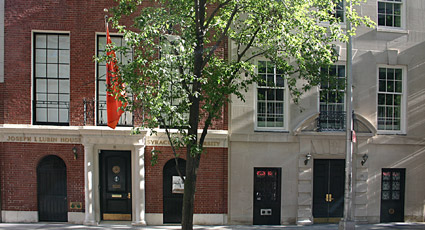
SU's Lubin House
Syracuse University's Lubin House in New York City. Image from Syracuse University (c)

The workshop aimed to respond to two parallel trends: the increasing popularity of such software packages among researchers and the movement towards data sharing, including the sharing of qualitative and multi-method data. As data repositories move to archive, preserve, and publish CAQDAS-based data projects, they will face a range of challenges that the participants discussed in the workshop’s four sessions.

Data repositories work closely with scholars, advising them on how to manage their data during their research, and then curating that data before publication. With those two roles in mind, the workshop began by clarifying best practices for shareable CAQDAS projects: what makes a project high quality, what components add values for secondary use, and what is key to allow for others to understand the data? As with all data, good documentation is key for understanding and potentially using them. More specific to CAQDAS software is the ability to annotate key decisions in the research process either via memos or by annotating, for example, coding labels. While we also considered the potential for automated logging to facilitate some of these tasks, most participants were skeptical of its practicability, at least given current technology. There was significant interest in providing guidelines and templates for “archivable” CAQDAS, which could be provided by data repositories or even built into software.

A key requirement for the digital preservation of data is the availability of an open, well-documented exchange format. This mitigates the risk that data depend on particular software, which over time may change or even disappear. Louise Corti of the UK Data service presented a brief overview of the QuDEx format, developed for this purpose. As of yet, however, QuDEx has not been widely adopted. More recently, efforts to develop an exchange format were renewed by KWALON, the Netherlands Association for Qualitative Research. With this guidance, a large group of CAQDAS developers is discussing a joint data-exchange standard. The dialogue at the Lubin House workshop session centered around key and minimal components of a standard and how to balance comprehensiveness with the burden (and thus the likelihood) for widespread implementation and adoption.

In a final session, participants discussed the prospects for enhanced publication of CAQDAS-based projects, reflecting on the role repositories can play in adding value when publishing data. Both the retrieval of information based on specific codes and, where possible, the combination of different CAQDAS projects were mentioned as exciting possibilities. Visualization – both of individual projects and of multiple projects or even the entire repository – was the other prospect that elicited most excitement. Some of these proposals may require a homogeneity among CAQDAS projects that is neither likely nor desirable, but may still be applicable to specific subsets, e.g. within a specific research program. Others, like visualization, will help repositories to serve not just as stewards but also as value-added publishers of research data.

The workshop produced a great many promising ideas and a long list of to-dos. QDR is looking forward to continue collaborating with the dynamic group of participants, as well as with other interested parties. Do you do work using CAQDAS software and may be interested in depositing your data? Or do you develop CAQDAS software and want to learn more about the needs for archiving and preserving CAQDAS projects? Please contact us at qdr@syr.edu.